

Here’s a phrase I never knew existed and will probably never use outside this post - doxastic involuntarism. It is the notion that humans do not choose what they believe. Of the thousands of beliefs we hold, not a single one is the result of choice. Instead, it is the result of forces compelling our minds to accept that belief. Philosophers tacitly agree that this is the case; if so, what are the implications?
Can we criticise people for their beliefs if they’re not responsible for what they believe, and how can we change the beliefs of others?
I got to thinking about this with the recent passing of one of my intellectual heroes: Scott Adams. He died on the 13th of January, 2026, from cancer. For over 2500 episodes, I listened to him every day for about 7 years. He has influenced my thinking more than anyone. He was insightful, smart, and judicious with his words. This is why when he told his audience that he plans to convert to Christianity, my ears perked up. This didn’t add up. Least of all because he previously said religion didn’t make sense to him - he was a non-believer and accepted simulation theory as true, but mostly because that’s not how beliefs work. He didn’t say he has converted; he said he plans to.
What are beliefs?
A belief isn’t something we can hold. We can’t measure it. It has no texture. Yet the world is filled with people who kill and die by them.
A belief is a fact about the world that someone thinks is true. It doesn’t have to be true; it doesn’t have to make sense or even be rational. The only thing that’s required is to genuinely believe it’s true.
Beliefs are formed in our minds, which come from our thoughts. External influences can guide us in certain directions, and these influences can come in the form of arguments, self-reflection or a personal experience, but it all falls under the banner of ‘information’. Beliefs change when new data enters the system. Like a job interview, the mind has a sit-down with this information, a subconscious confrontation begins, and this process - sometimes brief, sometimes lengthy - can lead to a change in our beliefs. At some point during this conversation, a switch is flicked, and there’s a realisation of a change in belief: you were convinced by the evidence. However, during this entire process, there was no choice. You didn’t choose to be convinced; you were convinced.
Still not persuaded? Let’s try a basic exercise. You, because you’re smart, believe that 2 + 2 = 4. If you think you decide what you believe, for the next 30 seconds, try to genuinely believe 2 + 2 equals anything other than 4. Just try it. You can tell yourself it equals 5, you can write it down on the paper in front of you or scream it into the mirror, but that’s not the same as believing, is it? You simply cannot choose to sincerely believe something you do not believe; your brain says “nope, this doesn’t track”.
But if I were to show you proof that 2 + 2 does equal 5, as soon as you understood, your brain would go “ohh, I get it”. But at no point would you make the conscious decision to believe 2 + 2 = 5. It just happened.
This is why when Scott said, “it is my plan to convert”, I was bewildered. To convert to Christianity, he has to think Christianity is true. And here he is saying that he plans to believe Christianity is true, as if he knows the evidence will convince him. I find it hard to believe that someone as curious as him went his whole life without looking into the arguments for theism.
A few days later, he posted this:

Turns out, he was employing Pascal’s Wager. He wasn’t a believer; he just said he accepted Jesus Christ, as if those words had magical powers and an omniscient God wouldn’t be able to see this as a risk-reward analysis. His conversion didn’t come from a place of genuine belief, because as we’ve learned, you can’t will yourself into believing something. He was a non-believer at the time of his death and decided to try hedge his bets.
Let me be clear: this has nothing to do with Scott Adams or Christianity. This applies to every person and every belief system. You don’t plan to believe anything. There is no choice. You are only a believer once the belief becomes convincing enough. And you won’t know this until the moment you are convinced.
It sounds like I’m saying there’s no freedom here at all, and… yeah. If you’d like to smuggle in some free will, you can do so by saying we choose to expose ourselves to new information. Doxastic involuntarism remains true. We can’t stop ourselves from believing something, but we can try to prevent new data from coming in.
How to change someone’s beliefs when they can’t change their own
Do not insult someone for what they believe if you’d like to change their mind. This is a non-starter. Calling them stupid or evil only entrenches them further.
If a particular belief is harmful, it may be worth explaining the pain it causes. However, I’m not going to stop believing something is true just because it might be harmful. Remember, I can’t stop believing what I think is true.
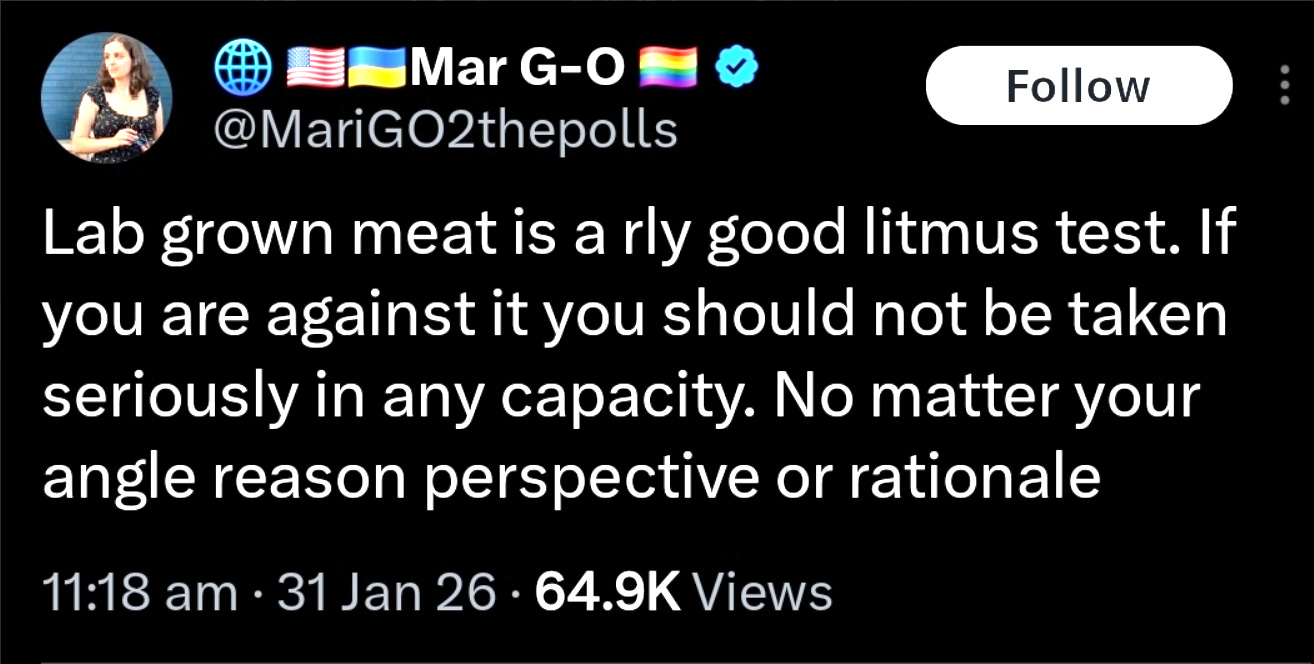
A better way is to see how people react to new information: do they get angry or inquisitive? Do they recoil in disgust or ponder in curiosity? Rejecting information that challenges a belief indicates a refusal to learn, and this is a far more valid criticism than of the belief itself. If you can help someone become more open to new information, it can lead to a change in beliefs. Calling them a dumbass does not.
The tough part is that even if we provide good evidence that someone is wrong, cognitive dissonance can prevent otherwise reasonable people from changing their minds.
It’s important to remember we’re all different and not all information is the same - what convinces one person may not convince another. If someone doesn’t change their mind, that doesn't mean they’re evil, stupid, or a liar. People often reject evidence. We must be mindful of how people come to believe different things while recognising that nobody chooses their beliefs.
I realise I’ve painted quite a bleak picture. We can’t directly change others’ beliefs. And even when we give others the right information, they may not change their mind.
It’s beyond frustrating. But there is no alternative. The only way to convince anyone of anything is to provide new information; it’s no easy task, however, the door for dialogue must remain open. If you shut it, they have a 0% chance of changing their mind.
Everyone can change
There is a belief roaming the world that some people are too far gone, that there’s no point trying to change their mind, we must shun and remove them from society, and usually this concerns one specific belief - racism. This is categorically false. Darryl Davis is living proof of this. Racism is just another belief; there’s nothing special about it that makes it impossible for them to change their minds.
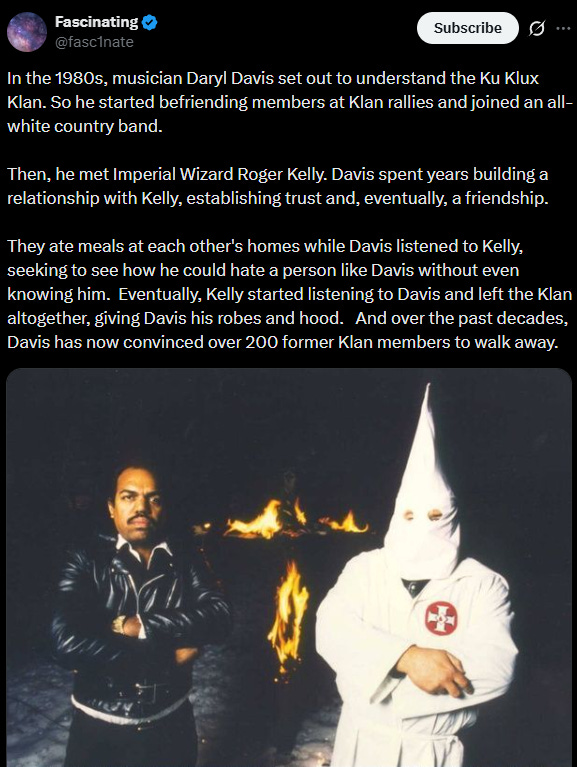
It matters less how abhorrent the belief is and more how strongly they believe it, which determines how much work it takes to change their mind. But it is always possible. Anyone can be convinced of anything. If the most radical Muslim can be deconverted, or the most horrible racist can give up their robes, anyone can have a change of heart. It’s all about what information we are exposed to.
If the situation were different, you could have been enticed to believe similar things. Nobody is a lost cause.