

Michael Phelps won four gold medals and two silvers at the 2012 London Olympic Games, becoming the most decorated Olympian of all time. Altogether, he holds 28 medals (23 gold) and has broken 29 individual records. Yet, shortly after his monumental success at the 2012 Olympics, he contemplated suicide. He accomplished one of the greatest sporting achievements of all time, yet he wasn’t happy.
Michael Phelps fell for what is called the Arrival Fallacy — the mistaken belief that once we reach our set goal or milestone, we achieve lasting happiness. This doesn’t just affect Olympians; it affects everyone. It’s a fallacy we all know, not because of the stories we’ve heard, but because it’s happened to all of us, and yet we rarely heed our own experience.
We all chase something. We’re on life's hedonic treadmill, reaching for what we believe will make us happy, sometimes to the point of exhaustion. Each time we speed up, the treadmill matches. We tell ourselves once we get that thing we’re chasing, maybe, just maybe, we’ll be happy. Yet this is sadly not the case
It wasn’t until I discovered Arthur C. Brooks and his study of the 13th-century philosopher Tomas Aquinas that things started to make sense for me (I love when someone else has done the hard work for me). After reading his book, From Strength to Strength, and listening to numerous podcasts, I had to share what I learned.
If you’d like to watch the podcast that dragged me down the rabbit hole, it all started with this one:
Let’s diagnose the issue.
According to Brooks and Aquinas, we all have a primary idol we submit to. These are motivators that drive our choices in a futile attempt to make us happy. Discovering this idol helps us understand the secret ‘why’ behind many of our decisions.
The four idols are fame, power, pleasure, and money. Let’s go through them.
The Four Idols
Fame:
This isn’t necessarily celebrity status or Instagram fame. It’s more about recognition, admiration, or prestige. It’s being valued by others. Whether in the music scene, the scientific community, or as a friend, those who chase fame love the idea of walking into a room and knowing heads turn in awe: “You see that? I can’t believe they’re here” or “That’s the guy!”
Power:
These people are drawn to positions of power, not always malevolently, but because they want to make things happen. It’s influence over other people. They want to call the shots, give instructions, and take responsibility.
Pleasure:
This comes in the form of self-gratification. They try to enjoy every moment of their lives, living comfortably while minimising discomfort. It’s about valuing experiences over things, and having the time to do as one pleases.
Money:
This one is self-explanatory. It’s financial security; seeing the total digits in one’s account go up. It’s about having nice things and being able to provide for themselves and others.
Let’s discover your idol.
What’s your idol?
Brookes likes to play a game called ‘What’s my Idol?’.
We start from the bottom and ask, ‘What idol is least appealing?’ This doesn’t mean being completely bereft of it; it means you are the population average. Could you suffice with the average salary? If yes, money isn’t your idol. Are you okay with being just as well known as the local supermarket clerk? If yes, you can cross fame off your list. Keep going one by one until you’re left with one, and that’s your idol. The last two usually require deep thinking.
If someone accepts a promotion at work, can we infer what their idol is? Power may be the first that comes to mind, as they advance on the career hierarchy. However, with a promotion comes a raise — maybe it’s a monetary incentive? Or maybe they want success — that’s fame creeping into the equation. Lastly, the job may give them more time for other, non-work activities: that’s pleasure. To figure out someone’s idol, one must look at the intention behind their actions and ask: why are they doing this?
Think about a potential job that limits each idol; if there’s one you can’t stand to be without, that might be yours.
Idols can cross-contaminate. Fame gives easier access to power, and vice versa. Money can easily give a false positive, as everyone enjoys having extra money: ‘A free $10,000 with no strings attached? No thanks.’ — said no one ever. Money can masquerade as other idols because it provides ample opportunity for more pleasure, fame, and power.
My idol is pleasure. I can easily overindulge in certain activities at the expense of other areas of my life. Read my post about my addiction here. Basically, I can become so obsessed with a certain type of game that my life falls into decay. Every measure of my life becomes significantly worse. I will play for 10 hours straight; I starve myself, and my fitness deteriorates because I cannot stop playing these games.
You might ask why I’d play in the first place? It may seem counterintuitive, but I enjoy every minute of it. Immensely. However, at the end of the day, I am deeply unsatisfied.
Maybe pursuing our idols doesn’t make us happy after all?
Leave a comment and let me know which idol you are, and why.
The hedonic treadmill and baseline happiness.
We’ve all had those moments when something outstanding happened — a new relationship, a holiday, a thoughtful gift — and you felt a tremendous sense of accomplishment. But this feeling doesn’t last; in fact, it’s designed not to. It’s an evolutionary feature to never be satisfied. That honeymoon phase will fade, and eventually you return to your baseline level of happiness. This is the hedonic treadmill in action, and only when you get off the hedonic treadmill do you realise how tired you are, and how unnecessary the running was.
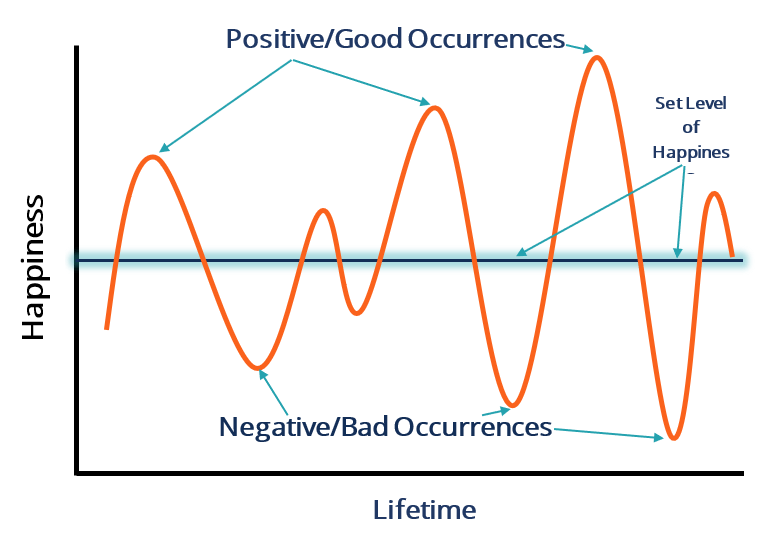
This is what chasing our idol looks like. We finally achieve our goal; we satiate that idol. We ride that high, thinking “I finally made it!” Then, slowly, time chips away at our elation. It slips from us, and we’re back to where we were before it all happened. These are transient moments on our journey to happiness.
Let me be clear: these idols aren’t inherently bad; they can easily serve the greater good. There’s no need to shy away from an opportunity to make more money just because that’s your idol. But you should also focus on what lasts after those fleeting moments of success, not on short-term rewards.
For the future.
So, if not my idol, what will make me happy? One of the best ways to answer this is to ask people nearing the end of their lives about their regrets. Did they regret not working harder, or wish they’d bought a bigger house? No. It wasn’t extrinsic rewards they regretted; it was the absence of intrinsic fulfilment, particularly in their relationships and how they viewed themselves.
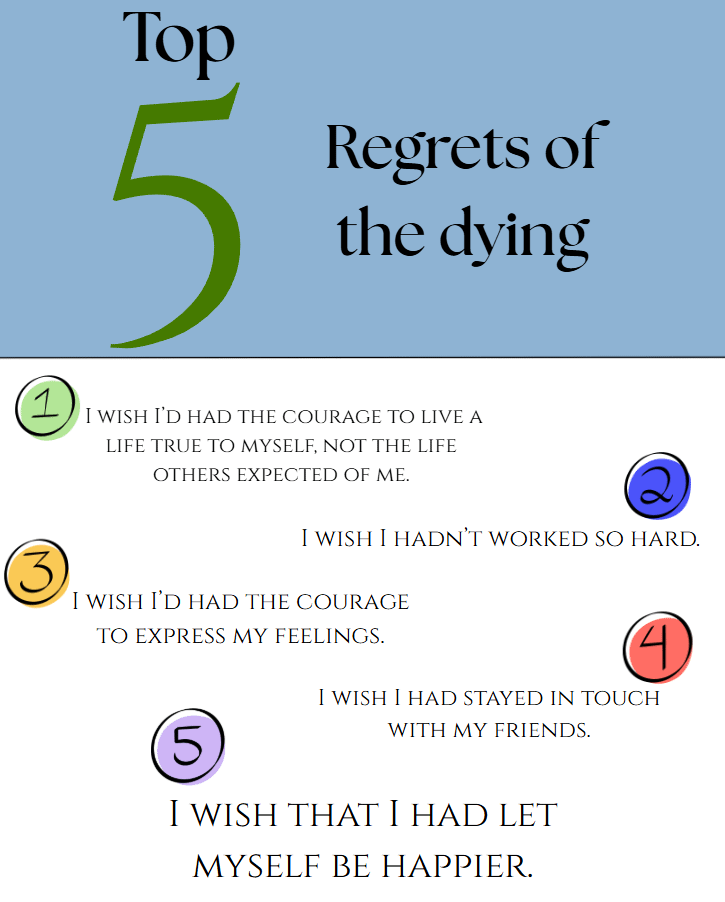
The issue with chasing an idol is that it’s a game of relative comparison. There’s always a more powerful position to attain, more stuff to buy, and someone more famous than you. Sacrifices to the idols are never-ending. Instead, to be happy, one must look inward. We should seek good relationships, derive purpose, and pursue education. These pursuits prolong your happiness because the process is satisfying; you get a win every time you engage in these behaviours, not a one-time payout when you achieve your goal. Relationships, purpose, and education last beyond an immediate win; they are intrinsic rewards that stay with us until death.
We started with the greatest Olympian of all time, and we’ll end with him too. Michael Phelps went on to create the Michael Phelps Foundation, which helps young people manage mental wellness and promotes healthy living. He had this to say:
“By sharing my experience, I have the chance to reach people and save lives, and that's way more powerful. Those moments and those feelings and those emotions for me are light years better than winning the Olympic gold medal.”
He found lasting happiness through altruism, not his records or 23 gold medals. Maybe we can learn something from that.